Eco-responsible offices: which certifications to choose?

Eco-friendly offices: Which certifications should you prioritize?

Faced with growing environmental challenges and regulatory requirements, more and more companies are incorporating ecological criteria into their office layouts.

Choosing sustainable workspaces not only reduces the carbon footprint but also improves employee comfort and enhances the company’s image. To ensure optimal environmental performance, several certifications are available. They provide clear guidelines and facilitate the implementation of a responsible approach. 

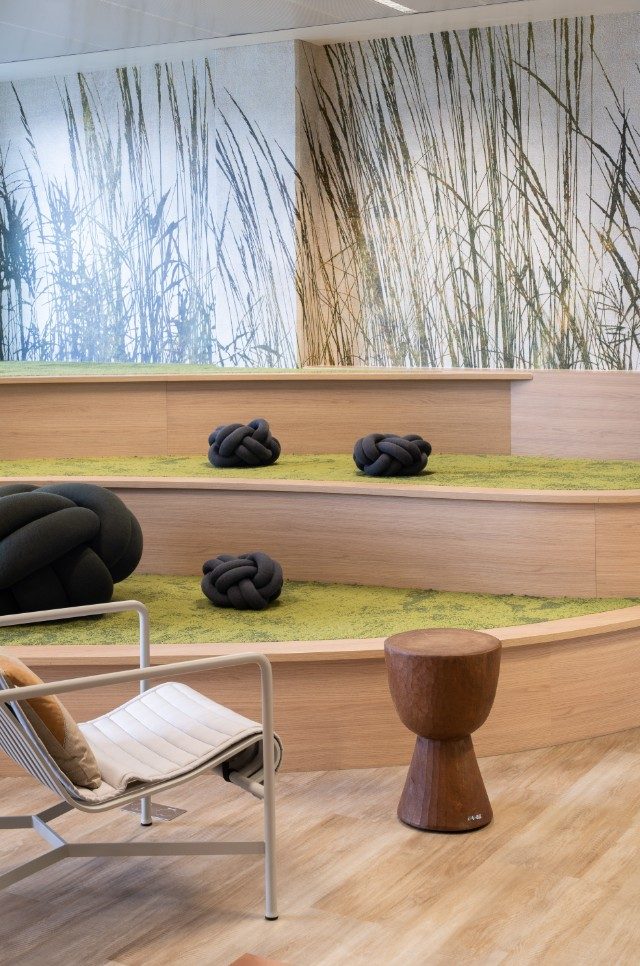
A cozy and natural-looking gathering space in a lecture hall - Rocher Group

Labels to structure a sustainable approach

Obtaining environmental certification enables companies to ensure that their offices meet precise criteria in terms of energy efficiency, resource management and occupant well-being. These labels also offer official recognition of the efforts undertaken, and can be a strategic asset in the eyes of customers and investors.

Among the most widespread certifications, the HQE (Haute Qualité Environnementale) standard stands out for its global approach, assessing energy performance, water and waste management, and indoor air quality. It is particularly well-suited to construction and renovation projects.

The BREEAM (Building Research Establishment Environmental Assessment Method) label is widely used in Europe. It analyzes a number of criteria, including the building's carbon footprint, energy consumption and landscaping. More flexible than other labels, it can be applied to both new and existing buildings.

LEED and WELL: a user-centred approach

The LEED (Leadership in Energy and Environmental Design) label is one of the most internationally recognized. It is based on a multi-criteria evaluation, including energy efficiency, use of sustainable materials and responsible waste management. It applies to both new buildings and renovations, and encourages an eco-designed approach at every stage of the project.

WELL certification focuses on occupant well-being. It assesses parameters such as air quality, access to natural light, thermal and acoustic comfort, as well as the provision of spaces that promote employee health and productivity. More and more eco-responsible offices are integrating this dimension to offer a healthier, more stimulating working environment.

Transition facilitated by appropriate certification

Choosing the right certification for your offices will enable you to structure an ambitious environmental approach and obtain official recognition for your efforts. Beyond labels, the challenge for companies is to adopt a global approach to sustainable development, integrating energy-efficient solutions, optimized resource management and a layout focused on employee well-being.  

You may also like...

Conflict-free real estate consulting
- Parella has placed the end-user at the heart of its business model. Through its three divisions...

Changing employee expectations regarding their work environment
― The world of work is undergoing a profound transformation, driven by the rise of remote work, digitalization...

Flexibility in your rental commitments
- Do you know how many m² will be needed to support your growth in 3, 6 or 9 years' time?

Company removals: mistakes to avoid to optimize your budget

Office Relocation: Mistakes to Avoid to Make the Most of Your Budget.

A company move is a strategic step involving significant costs and rigorous organization. Poorly prepared, it can lead to budget overruns and operational disruptions.

To avoid these pitfalls, it's essential to anticipate each stage of the project and optimize expenditure, while ensuring a smooth transition for employees. 

Moving offices Credits: iStock

Underestimating the planning phase

One of the most common mistakes is not giving enough time to preparing for the move. Lack of forethought can result in unforeseen costs, linked to contracts not terminated on time, hasty logistical organization or last-minute adjustments to the new space.

To optimize your budget, it's essential to draw up precise specifications, including detailed back-planning, a needs assessment and realistic budgeting.


Planning must also take into account negotiations with service providers. Comparing several quotations, anticipating the clauses of the new lease and forecasting the costs of refurbishing the old premises are all elements that can help avoid unpleasant financial surprises.

Neglecting space optimization

A move is an ideal opportunity to rethink office layout and optimize leased space. Keeping an organization similar to that of the old premises without taking into account new uses can lead to under-utilized space and therefore unnecessary costs.

With the rise of
flex office and telecommuting, many companies can reduce their real estate footprint while improving team comfort and productivity. A detailed analysis of real needs enables offices to be sized efficiently, modular spaces to be integrated and costs per square metre to be optimized.

Underestimating employee support

A move can be a source of stress for teams, particularly if they are not sufficiently involved in advance. A lack of communication, or a failure to take expectations into account, can have an impact on motivation and support for the project.

Employee support should be included in the relocation budget. This may take the form of information sessions, change management support, or specific space planning to accommodate new working methods. The key to a successful transition is to ensure that employees' well-being is taken into account and that they can adapt to new working habits.

Forgetting hidden costs

There's much more to a move than just the cost of transport and fitting out the new premises. Many indirect costs can have an impact on the budget if they are not anticipated: costs of refurbishing the old offices, bringing the new space up to standard, installation of IT equipment, or even loss of productivity due to the transition.

It's also important to allow for unforeseen circumstances. A delay in the delivery of the new offices, additional work or unanticipated administrative costs can quickly add up.

You may also like...

Interview Business Immo
- Parella has placed the end-user at the heart of its business model.
Increase in ILAT
Increase in ILAT
- With the steady rise in the index of rents for commercial activities (Indice des Loyers des Activités Tertiaires - ILAT), companies...
Are we really responsible?
― Specifications involve much more than one might think: Matteo Bonotto, Design Manager at Agilité, discusses...

Commercial or professional lease: which should you choose for your business?

Commercial lease or professional lease? Which one should you choose for your business?

When launching or expanding a business, choosing the right lease for your premises is a key step that directly influences the stability and development of your business.

Should you choose a commercial lease or a professional lease? Each type meets specific needs and is suited to very specific types of businesses.

Discussion and exchange regarding a legal document. Credit: iStock

the commercial lease

Commercial leases are intended for companies engaged in commercial, industrial or craft activities. It is governed by strict rules that protect both lessee and lessor. This type of contract is concluded for a minimum term of nine years, enabling the company to secure its location for the long term. This stability is a major asset for businesses needing a fixed location to attract and retain customers. Despite this relatively long term, tenants have the option of terminating their lease every three years, giving them a degree of flexibility while maintaining a structured framework.

One of the main advantages of a commercial lease is the right to renew, guaranteeing tenants the possibility of extending their contract on expiry, except in certain exceptional cases. It also allows for sub-letting or assignment under certain conditions, giving businesses additional room for manoeuvre. Rent is generally reviewed every three years, based on a specific index, to ensure that it reflects market realities, although this review can sometimes lead to significant increases, particularly during periods of inflation.

professional leases

The professional lease, on the other hand, is intended for liberal professions such as doctors, lawyers, architects or consultants. It is designed for non-commercial activities requiring premises for the exercise of the profession, but without the specific requirements associated with commerce.

Unlike a commercial lease, the lease term is generally six years, providing greater flexibility for professionals whose business may evolve rapidly. This flexibility is reinforced by the possibility of terminating the lease at any time, provided six months' notice is given. Another advantage of a professional lease is its more stable financial framework, since the rent is not systematically subject to a three-yearly review. However, it can be readjusted if a specific clause so authorizes, although this situation is less frequent and less restrictive than for a commercial lease.
Less legally regulated, this type of lease nevertheless offers fewer guarantees for the tenant, who does not benefit from an automatic right to renewal or the same protections in the event of a dispute with the lessor.

The choice between a commercial and a professional lease depends on the activity carried out and the specific needs of the business. Commercial, industrial or craft businesses will prefer a commercial lease for its legal protection and stability, while the liberal professions will opt for the more flexible professional lease. Before signing, it's essential to anticipate your objectives and check that the contract matches your strategy. The assistance of a legal expert is recommended to secure your commitment. 

You may also like...

Conflict-free real estate consulting
- Parella has placed the end-user at the heart of its business model. Through its three divisions...
Optimizing real estate costs: how to reduce your rental charges?
- In an economic context where cost reduction is a priority, rental expenses represent a significant...
Parella Paris appoints three new Partners
- Parella , a key player in the field of corporate real estate consulting and development...

Green Lease: everything you need to know about green leases and their advantages

THE GREEN LEASE: Everything You Need to Know About Green Leases and Their Benefits

Green Lease is more than a lease: it's a shared commitment to a more eco-responsible building. It includes clauses on energy performance, reduction of CO2 emissions and optimization of resources.

This collaboration enables us to limit our ecological footprint while cutting costs thanks to high-performance equipment and sustainable practices.

Illustration of a modern, eco-friendly reception area. Credit: iStock

Strategic leverage for companies

Opting for a Green Lease offers several advantages. Firstly, it enables a significant reduction in energy and resource management costs, while facilitating compliance with constantly evolving environmental standards.

Secondly, it improves the company's image in the eyes of consumers, partners and investors who are sensitive to ecological issues. Finally, a more environmentally-friendly working environment, with better air quality and healthy materials, promotes employee satisfaction and productivity. This type of lease is based on measurable commitments, often verified by audits and certifications such as BREEAM or LEED, guaranteeing compliance with sustainability criteria.

An investment in the future

Green Leasing is much more than just a trend: it's a sustainable strategy for companies wishing to combine environmental responsibility, cost optimization and attractiveness.

At Parella, we support our customers in this transition, offering them real estate solutions tailored to their ecological and economic ambitions. Adopting a Green Lease means investing in a more responsible and competitive future.

You may also like...

Maison & Objet 2025
Maison & Objet 2025
Once again present at the Maison & Objet trade show, Parella continues to fuel its thinking by exploring...
THE LENGTH OF STAY IN COMMERCIAL INTERIORS
― For years, dwell time has been a familiar indicator in retail.
Company removals: mistakes to avoid to optimize your budget
- A company move is a strategic step that involves significant costs and organization...

How are rising interest rates affecting commercial real estate?

Rising interest rates

How do rising interest rates affect commercial real estate? Rising interest rates are profoundly changing the commercial real estate landscape.

As borrowing costs rise, investors are facing a more expensive market and tighter financing conditions.

Tenant companies, meanwhile, are seeing their charges rise, as these costs are passed on by lessors. Faced with these economic challenges, a strategic, agile approach is essential. 

Photo illustration Home Parella + About + Workplace + articles

Reducing demand and adjusting rents

Rising interest rates have a direct impact on demand for commercial real estate. Indeed, companies are more reluctant to commit to new acquisitions or sign new leases, as the cost of credit has become higher.

This slowdown particularly affects sectors such as office property and retail, which are more sensitive to these fluctuations. The logistics sector, on the other hand, seems to be holding up better, buoyed by the continuing growth of e-commerce.

At the same time, rising interest rates are leading to a readjustment in rents. In high-demand areas, rents continue to rise, while in less attractive sectors, landlords sometimes have to adjust their expectations to attract new tenants.

Development project delays and adaptation strategies

Rising interest rates are also having an impact on real estate development projects. Access to financing is becoming more restrictive, and many developers are forced to delay certain projects or revise their profitability targets downwards.

The valuation of real estate assets may also be revised, as investors now factor higher financing costs into their calculations. For tenant companies, this translates into a reassessment of space requirements, with an increased tendency to look for more flexible solutions, such as shorter leases or shared space.

Faced with this new situation, investors need to diversify their assets and explore alternative financing methods to reduce their exposure to risks linked to interest rate fluctuations. In this context, an agile, well-thought-out strategy is essential to secure investments and control costs.

You may also like...

Proptech: how is technology revolutionizing commercial real estate?
- Commercial real estate is undergoing a profound transformation, driven by new technologies and the...
ART IN THE OFFICE
ART IN THE OFFICE
― I deeply believe that art has this power: to transform the perception of a space, to stimulate...
Parella in Copenhagen for 3daysofdesign 2025: KEEP IT REAL
- Like every year, Parella was in Copenhagen for the 3 daysofdesign, a not-to-be-missed event...
Article Office Paper

OFFICE PAPERS

Small living room with red and yellow armchairs, light wood coffee table, at NAOS, by Parella

THANK YOU

Your message has been sent.
We'll get back to you shortly!